Shift of Proposal Value Distribution

This page details the analysis in Section 4.1 and Figure 5: how increasing ToM order changes the coupling between what an agent requests and what it offers in negotiation.

Paper Section 4.1 Figure 5 m-r Strategic Map

Data Construction per Proposal

For each trade proposal, the paper uses the proposer's own V0 report to score both sides of the exchange.

  • Request value: sum of V0 values for items requested from partner.
  • Offer value: sum of V0 values for items offered by proposer.
  • Point cloud: each proposal becomes one point in (request, offer) space.
  • Settings: repeat for zero-/first-/second-order elicitation and for each model.

Key design choice: the valuation source is internal (agent-reported V0), so fairness is measured in the agent's own utility space.
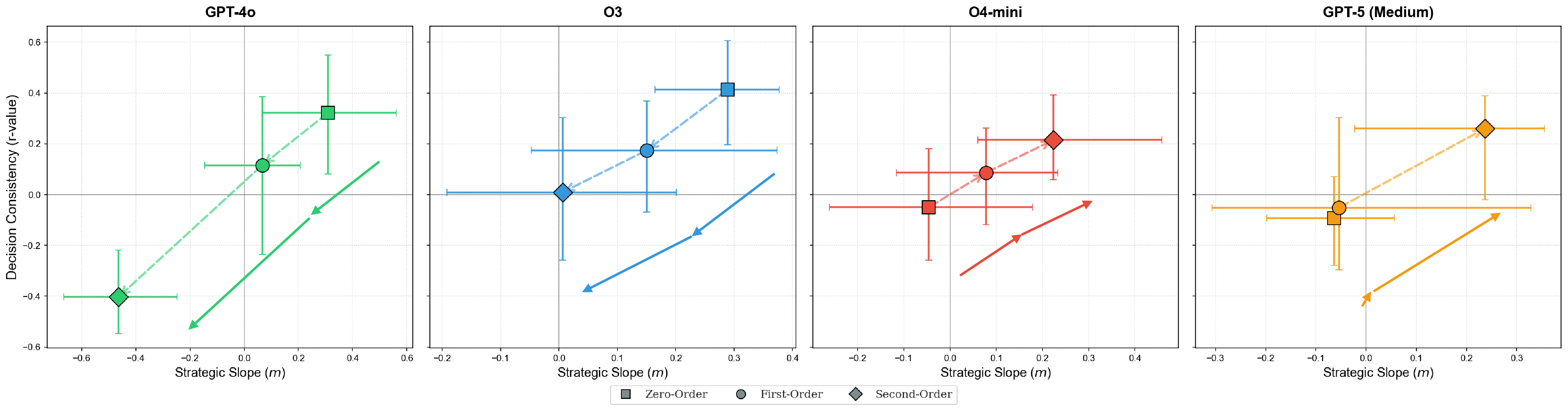
Figure 5 strategic consistency map with slope m and correlation r
Figure 5. Strategic consistency map (m-r space) with 90% bootstrap CI (B=2000). Arrows connect zero -> first -> second order.

Correlation and Exchange-Rate Proxy

Two Complementary Signals

The analysis tracks both coupling strength and directional fairness.

\[ r=\mathrm{PearsonCorr}\!\left(v_{\mathrm{request}},\,v_{\mathrm{offer}}\right) \]

\[ m=\mathrm{slope}\!\left(\mathrm{LinearFit}(v_{\mathrm{request}},\,v_{\mathrm{offer}})\right) \]

Interpretation: \(m\approx 1\) fair exchange, \(m<1\) more aggressive/selfish, \(m>1\) more concessive.

Confidence intervals are estimated by episode-level bootstrap (B=2000), resampling episodes/questions rather than individual proposals.

Signal A r captures coupling between ask and give.
Signal B m captures negotiation aggressiveness.
Trajectory Arrow direction shows ToM-order effect.
Claim Different model generations move in opposite directions.

Model-by-Model Trajectories

GPT-4o

As ToM order increases, trajectory moves toward lower m and lower/unstable r, indicating weaker value coupling and greedier exchange behavior.

o3

Shows a similar early-generation pattern: higher-order reports do not automatically yield fairer proposal structures in value space.

o4-mini

Marks the transition regime. Increasing ToM order tends to move points toward stronger coupling and more balanced exchange slope.

GPT-5 (medium)

Most consistent positive shift: higher ToM order aligns with improved offer-request consistency and more value-aligned proposals.

What This Means for Strategic ToM

Core Conclusion from Section 4.1

The effect of higher-order ToM elicitation is not monotonic and not universal. For some models it degrades exchange fairness, while for later generations it improves value alignment.

  • ToM traces can act as either useful strategic signals or additional noise, depending on model generation.
  • This supports the paper's claim that ToM expression and policy-level integration are separable capabilities.
  • Behavioral strategy transition appears around the o4-mini / GPT-5 generation boundary.

Methodological Caveats

  • The fairness metric is internal-value-based, not welfare-optimality across players.
  • Single-run-per-instance design may leave variance for rare negotiation trajectories.
  • Results are from self-play and may differ under human-agent interaction.